Bharathanatyam: The Language of the Body, the Soul of the South
Long before stories were written down, people used movement, rhythm, music, and expression to communicate. Bharatanatyam is one of India’s most sophisticated classical dance traditions, bringing all of these elements together through a highly disciplined vocabulary of movement and expression.
Originating in Tamil Nadu, Bharatanatyam has a long history connected with temples, devotional traditions, music, and classical performance theory. Over time, it moved from temple settings to the modern stage, underwent significant changes during the colonial and post-colonial periods, and eventually became one of the most widely recognised Indian classical dance forms.
But Bharatanatyam is much more than a sequence of movements. Its language is built through rhythm, gestures, facial expressions, body positions, music, and storytelling. A dancer can use a single hand gesture to represent an object, an action, or an idea, while subtle changes in facial expression can communicate emotions that words may struggle to express.
So, what makes Bharatanatyam so distinctive? To understand the dance, it helps to look at its history, movement vocabulary, performance structure, music, training tradition, and place in the modern world.
Where Did Bharatanatyam Begin?
Bharatanatyam developed in Tamil Nadu and has deep historical connections with South Indian temple and court traditions. For centuries, dance was performed in temples as part of devotional and cultural practices.
The dance tradition was associated with the devadasi community, women who were connected with temple service and who played an important role in preserving and performing the repertoire. Their contribution to the history of South Indian dance is significant, although the social position of devadasis changed considerably under colonial rule and later social reform movements.
The theoretical foundations of Indian classical performance traditions are closely associated with the Natya Shastra, an ancient Sanskrit treatise attributed to Bharata Muni. The text discusses theatre, dance, music, gesture, expression, and performance, providing an important theoretical foundation for many Indian performing arts.
It is worth noting that the commonly taught explanation that Bha, Ra, and Ta stand for bhava, raga, and tala is a later interpretive explanation rather than the established historical origin of the name Bharatanatyam.
During the 19th century, the Thanjavur Quartet played a major role in shaping and organising the repertoire that forms the foundation of modern Bharatanatyam performance. Their contribution helped establish a structured sequence of items that continues to influence performances today.
From Temple Tradition to the Modern Stage
The history of Bharatanatyam is not simply a story of uninterrupted continuity. The dance underwent major social and cultural changes during the late 19th and early 20th centuries.
Under colonial rule, attitudes towards temple dancers and their traditions became increasingly negative. Social reform movements also challenged the devadasi system. As a result, the traditional performance context of the dance changed dramatically.
At the same time, artists and cultural revivalists worked to bring Indian classical dance into new public spaces.
One of the most influential figures in this revival was Rukmini Devi Arundale, who played a major role in presenting the dance as a respected classical art form on the modern concert stage. In 1936, she founded Kalakshetra in Chennai, an institution that became highly influential in the teaching and presentation of Bharatanatyam.
The transition from temple and traditional performance contexts to the modern stage changed the way Bharatanatyam was presented, taught, and understood. Yet its core vocabulary of rhythm, movement, expression, and storytelling continued to remain central to the form.
The Two Major Dimensions: Nritta and Nritya
One of the easiest ways to understand Bharatanatyam is to look at the distinction between Nritta and Nritya.
Nritta: Pure Dance
Nritta refers to pure dance movement.
Here, the primary focus is on rhythm, movement, geometry, coordination, and technical precision rather than storytelling. The dancer’s footwork, body positions, rhythmic patterns, and controlled movements become the focus.
This is where the dancer’s mastery of tala, or rhythm, becomes particularly visible.
The basic movement units known as adavus form an important part of this technical vocabulary. Through combinations of footwork, arm movements, body positions, and rhythm, adavus create the foundation for more complex sequences.
Nritya: Expressive Dance
Nritya introduces meaning and emotion into movement.
Instead of simply presenting rhythmic patterns, the dancer uses gestures, facial expressions, body language, and music to communicate a story, character, emotion, or idea.
This expressive dimension is closely connected with abhinaya, the art of communicating meaning through performance.
A dancer may portray devotion, love, anger, compassion, humour, separation, or longing without speaking a single sentence. The audience understands the narrative through the dancer’s carefully controlled expressions and gestures.
Together, Nritta and Nritya allow Bharatanatyam to balance technical discipline with emotional storytelling.
The Body as a Language: Mudras and Adavus
If Bharatanatyam can be understood as a language, then its gestures and movements form its vocabulary.
Mudras
Mudras, also known as hastas, are hand gestures used to communicate meaning.
Classical dance traditions describe numerous hand gestures, and their meanings can change depending on the context in which they are used. A particular gesture may represent an object in one situation and communicate an action or idea in another.
This means that learning mudras is not simply about memorising hand positions. Dancers must understand how gestures work together with facial expressions, body movements, music, and the surrounding story.
Adavus
Adavus are fundamental movement units used in Bharatanatyam training.
They combine elements such as footwork, hand movements, body positions, and rhythm. Students practise these movements repeatedly to develop coordination, balance, rhythmic accuracy, and control.
Adavu practice forms one of the foundations of Bharatanatyam training. Before performing complex choreographies, students spend considerable time developing the physical and rhythmic skills needed to execute them correctly.
Aramandi
Another distinctive feature of Bharatanatyam is aramandi, a half-sitting posture in which the knees are turned outward.
The posture gives the dance its characteristic grounded appearance and allows dancers to create the strong geometric shapes associated with Bharatanatyam.
Maintaining aramandi correctly requires control, coordination, and physical conditioning, which is why posture training remains an important part of a dancer’s practice.
What Is the Margam in Bharatanatyam?
The Structure of a Bharatanatyam Performance: The Margam
A traditional Bharatanatyam recital is often organised according to a structured sequence known as the margam.
The repertoire was systematised significantly by the Thanjavur Quartet, and the traditional margam takes the audience through different levels of technical and expressive performance.
Alarippu
Alarippu is traditionally an opening item. It focuses primarily on rhythm and movement and gradually introduces the dancer’s body and coordination to the performance space.
Jatiswaram
Jatiswaram combines rhythmic patterns with melodic structure. It is primarily a pure-dance piece and gives the dancer an opportunity to demonstrate technical precision and rhythmic control.
Shabdam
Shabdam introduces a stronger expressive and narrative element. Lyrics and gestures are combined with dance, often expressing devotion or praise.
Varnam
The Varnam is traditionally the central and most demanding section of the recital.
It brings together Nritta and Nritya, requiring the dancer to demonstrate both technical ability and expressive depth. Because of its length and complexity, the Varnam can be one of the most challenging parts of a Bharatanatyam performance.
Padam and Javali
These are generally slower and more expressive pieces. They give the dancer greater space to explore abhinaya, emotions, relationships, devotion, and human experiences.
Tillana
The Tillana is usually energetic and rhythmically complex. It places strong emphasis on pure dance and often serves as one of the final major performance pieces.
Mangalam
A Mangalam may conclude the traditional recital as a gesture of auspiciousness, gratitude, or respect.
The exact repertoire and order can vary depending on the tradition, school, choreographer, and performance context.
Costume, Jewellery, and Music in Bharatanatyam
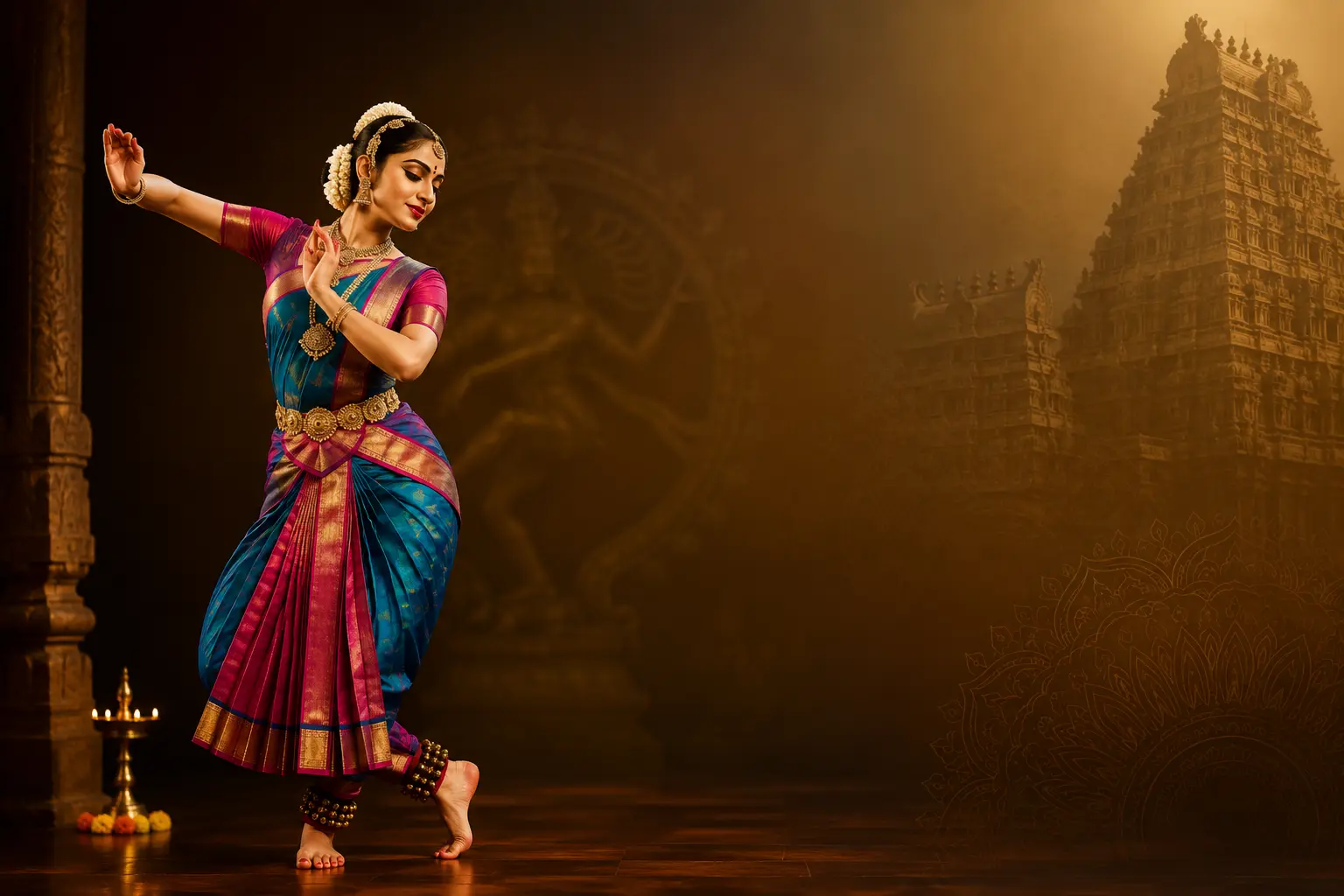
Bharatanatyam is immediately recognisable through its distinctive costume and visual presentation.
The traditional costume is designed to support movement while creating clear geometric lines. The pleated section of the costume opens dramatically during certain movements, highlighting the dancer’s footwork and posture.
Traditional jewellery is also an important part of the visual identity of Bharatanatyam. Dancers may wear temple-style jewellery, including earrings, necklaces, bangles, a waist belt, and head ornaments.
The salangai, or ankle bells, are particularly important. They emphasise the dancer’s footwork and connect movement directly with rhythm.
But the visual elements are only one part of the performance.
A traditional Bharatanatyam presentation is supported by a musical ensemble that may include:
- Vocalist
- Mridangam player
- Violinist or veena player
- Flute player
- Nattuvanar
The nattuvanar plays a particularly important role by conducting the rhythmic aspects of the performance and reciting rhythmic syllables known as sollukattu while playing the nattuvangam, a pair of small cymbals.
The dancer and musicians therefore function as a closely connected ensemble rather than separate performers.
Learning Bharatanatyam: The Guru-Shishya Tradition
Bharatanatyam requires years of disciplined training.
Traditionally, classical Indian arts have been taught through the guru-shishya parampara, a teacher-student tradition in which knowledge is passed from teacher to student through sustained learning and practice.
A Bharatanatyam student generally begins by learning fundamental postures, adavus, rhythm, gestures, and coordination before progressing to more complex items.
Regular practice is essential. Students gradually develop:
- Rhythmic precision
- Body coordination
- Balance
- Posture
- Flexibility
- Expression
- Musical understanding
- Stage confidence
One of the most important milestones in a dancer’s training is the arangetram, the formal debut performance of a student before an audience.
An arangetram is not simply a graduation ceremony. It represents an important stage in a dancer’s journey, demonstrating the training and repertoire they have developed under their teacher’s guidance.
The time required to reach this stage varies from student to student and depends on factors such as training frequency, learning tradition, individual progress, and the guru’s assessment.
Beginning Your Bharatanatyam Journey with Bharathanjali
Learning Bharatanatyam is a gradual process that requires consistent practice, proper technique, and guidance from an experienced teacher. A good learning environment can help students build a strong foundation while developing a deeper understanding of the art form.
Bharathanjali Dance School, with locations in Abu Dhabi and Musaffah, provides Bharatanatyam training under the best classical dance guru and performer, Smt. Priya Manoj. The focus is on helping students develop the essential aspects of the dance, including basic movements, rhythm, expressions, hand gestures, posture, and performance skills.
For students and parents looking for Bharatanatyam classes in the UAE, choosing a school that values both traditional technique and consistent learning can provide a strong foundation for long-term growth as a dancer.
Bharatanatyam in the Modern World
Bharatanatyam is no longer limited to the temples, courts, or performance spaces of Tamil Nadu. Today, it is practised across India and in many parts of the world.
Dance schools and cultural institutions teach Bharatanatyam to students from different backgrounds, while Indian diaspora communities have played an important role in carrying the tradition internationally.
At the same time, contemporary practitioners continue to explore new themes and presentation styles.
Some choreographers use Bharatanatyam vocabulary to engage with subjects such as identity, migration, gender, environment, social issues, and contemporary life. Others experiment with collaborations between Bharatanatyam and contemporary dance, theatre, or other artistic forms.
These developments raise important questions about tradition and innovation. How much can a classical form change while retaining its identity?
There is no single answer. Bharatanatyam has always existed within changing social and cultural environments. Its continued relevance comes partly from its ability to preserve its fundamental vocabulary while allowing artists to find new ways of expressing ideas through it.
Conclusion
Bharatanatyam is a classical dance tradition in which movement, rhythm, expression, music, and storytelling come together as one artistic language.
Its history reflects centuries of cultural change, from temple and court traditions to the modern stage and international performance spaces. Its technique continues to depend on disciplined training, while its expressive vocabulary allows dancers to communicate stories and emotions without relying entirely on spoken language.
From the precision of an adavus and the geometry of aramandi to the expressive possibilities of abhinaya, every element contributes to the distinctive character of the form.
What makes Bharatanatyam enduring is not simply its age. It is the way a carefully preserved artistic vocabulary continues to give dancers new possibilities for expression. Tradition provides its foundation, while each generation of dancers brings its own understanding, experience, and interpretation to the stage.