
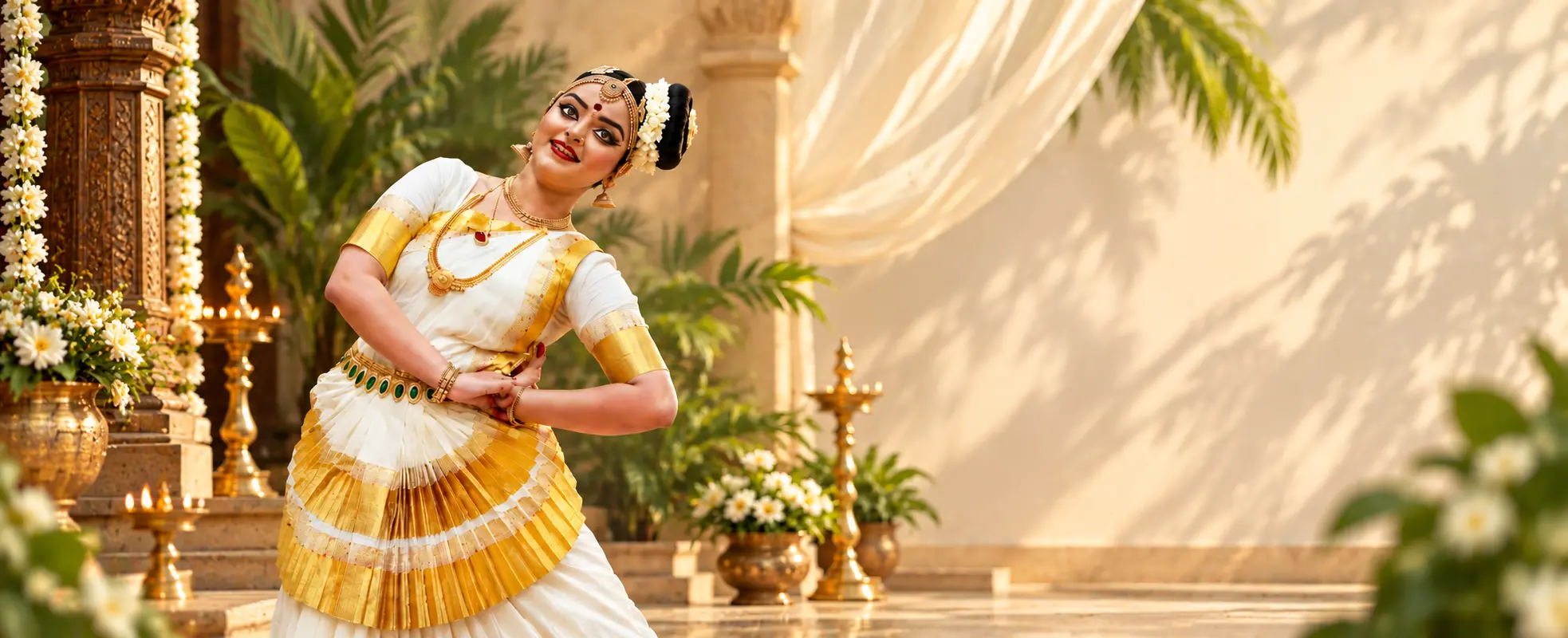
The Beauty of Mohiniyattam Dance: Movement, Expression, and Tradition
There are dances that tell a story through movement. There are dances that speak through expression. And then there is Mohiniyattam Dance, where movement, emotion and tradition come together in a language of remarkable grace.
Originating in Kerala, Mohiniyattam is one of India’s classical dance traditions. Often associated with graceful, flowing movements and the Lasya tradition, the dance form is known for its subtle expressions, gentle body movements and connection with music and storytelling.
But the beauty of Mohiniyattam goes far beyond its graceful appearance. Every movement, expression and gesture contributes to the story being told.
The Grace Within the Movement
The first thing many people notice about Mohiniyattam is its distinctive movement.
Unlike dance forms that often rely on sharp or highly energetic movements, Mohiniyattam is known for its gentle, flowing quality. The body moves with a controlled swaying motion, creating a sense of continuity rather than abruptness. The movements are graceful, yet they require considerable control, balance and training.
This characteristic movement is closely connected with Lasya, a graceful mode of dance described in Indian performance traditions. In Mohiniyattam, the dancer’s body, especially the torso, contributes to the soft and flowing visual quality of the performance.
What looks effortless on stage is actually the result of years of disciplined practice, control and training.
When Expression Becomes the Story
Movement alone cannot tell the whole story. One of the most captivating elements of Mohiniyattam is abhinaya—the art of expression.
Through the eyes, face, hands and body, the dancer communicates emotions and develops the story. Subtle facial expressions are particularly important, allowing the performer to convey feelings without relying on spoken words.
A slight change in the eyes, a carefully formed gesture or a change in facial expression can completely transform the meaning of a movement.
This is where Mohiniyattam becomes more than choreography. It becomes a conversation between the dancer and the audience.
The Language of Mudras
Hand gestures, or mudras, are another important part of classical dance expression. In Mohiniyattam, gestures help communicate characters, objects, actions and ideas as part of the larger narrative.
But a mudra is rarely meaningful on its own. Its interpretation is supported by the dancer’s expression, movement, music and the context of the story.
This combination allows a dancer to communicate complex ideas through a sequence of carefully coordinated movements.
Music That Moves With the Dancer
Music is an integral part of a Mohiniyattam performance. The dancer’s movements and expressions respond to the rhythm and lyrical content of the accompanying music.
Traditional Mohiniyattam repertoire includes pieces such as Cholkettu, Jatiswaram, Varnam, Padam and Thillana, although repertoire can vary between different schools and traditions.
The musical accompaniment can include instruments such as the mridangam or maddalam, violin or veena, flute and edakka, along with vocal music and rhythmic accompaniment.
Together, music and movement create the rhythm of the performance, while expression gives it emotional depth.
A Visual Identity Rooted in Kerala
Mohiniyattam is instantly recognisable not only through its movements but also through its traditional appearance.
The dancer is typically seen in an off-white or white costume with golden borders, accompanied by traditional jewellery and jasmine flowers adorning the hair. This visual simplicity contributes to the distinctive identity of the dance and its strong connection with Kerala’s cultural aesthetic.
The costume does not overpower the movement. Instead, it complements the dancer, allowing the subtle gestures and flowing movements to remain at the centre of the performance.
Stories of Love, Devotion and Emotion
Traditionally, Mohiniyattam repertoire has explored themes including love, devotion and emotional experience, while performers have also expanded the form to explore a wider range of themes and techniques.
This expressive quality gives the dancer space to portray different emotional states and narratives. The performance does not depend on dramatic movement alone; sometimes, a quiet expression or a restrained gesture can communicate just as much.
That subtlety is one of the qualities that makes Mohiniyattam distinctive.
Tradition That Continues to Evolve
Like any living art form, Mohiniyattam continues to develop while remaining connected to its traditional foundations.
Institutions such as Kerala Kalamandalam have played an important role in the teaching and revival of Mohiniyattam, helping carry the tradition to new generations.
Today, Mohiniyattam continues to be performed both in India and internationally. While its traditional vocabulary remains important, dancers and choreographers also explore new themes and presentation styles, showing that preserving a tradition does not necessarily mean keeping it frozen in time.
Bharathanjali and Mohiniyattam in Abu Dhabi
For students and families in Abu Dhabi and Mussafah, exploring Indian classical dance can be a way to stay connected with India’s rich artistic traditions while learning through structured practice.
Bharathanjali, guided by Priya Manoj, offers classical dance training in Abu Dhabi and Mussafah, with a focus on traditional technique, expression, rhythm and disciplined learning. Through its training approach, students can explore the beauty of Indian classical dance while developing a deeper understanding of its movements, expressions and storytelling traditions.
For those looking for Mohiniyattam dance classes in Abu Dhabi, Bharathanjali provides an opportunity to learn and experience this graceful classical dance tradition through structured training and regular practice.
With its emphasis on traditional foundations and expressive performance, Bharathanjali helps students discover the beauty of Mohiniyattam while developing their skills as dancers.
Explore Mohiniyattam dance classes in Abu Dhabi at Bharathanjali.
Discovering the Beauty of Mohiniyattam
To understand Mohiniyattam more closely, it helps to see how movement, expression, music and storytelling come together in performance. Watching the dance allows these elements to be experienced rather than simply described.
Because sometimes, the best way to understand a dance is not simply to read about it—but to watch how every movement speaks.
The Beauty That Remains
Mohiniyattam’s beauty lies in its balance.
It balances movement with stillness, technique with expression, music with rhythm, and tradition with contemporary interpretation. Its graceful movements may be what first catches the eye, but it is the emotion and storytelling that invite the audience to stay.
In every gesture, every glance and every flowing movement, Mohiniyattam carries a part of Kerala’s artistic heritage.
It doesn’t simply perform a story. It allows the story to move.