
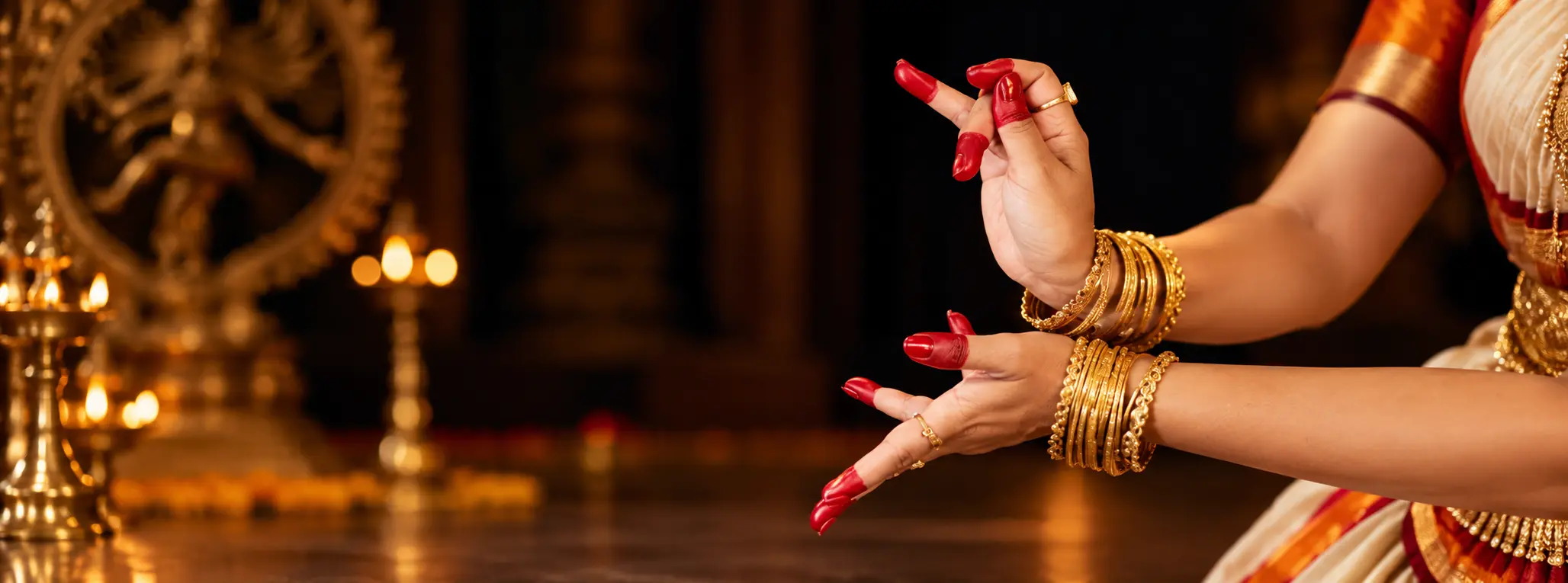
What Are Indian Classical Dance Mudras? Mudras in Bharatanatyam
Indian classical dance is a beautiful combination of movement, rhythm, music and expression. But there is another important element that often catches the eye—the hands. A dancer can move their hands in different positions and, through these gestures, communicate an idea, emotion, object or even an entire part of a story.
These meaningful hand gestures are known as mudras. They are an essential part of Indian classical dance and contribute greatly to the art of storytelling through movement.
What Are Mudras?
The word mudra refers to a symbolic gesture, often created through a particular positioning of the hands and fingers. In classical dance, mudras are used as a form of visual communication.
A gesture can represent something familiar, such as a flower, bird, tree, moon or an object. Depending on the context in which it is used, it can also help express an action, thought or emotion.
This makes mudras much more than simple hand movements. They become part of the dancer’s vocabulary—a visual language that allows stories to be communicated without relying entirely on spoken words.
The Language Behind the Gesture
What makes mudras fascinating is that their meaning does not exist in isolation. A dancer combines hand gestures with facial expressions, body movements, rhythm and music to create a complete expression.
For example, a hand gesture may represent an object, while the dancer’s expression and movement communicate what is happening around that object. Together, these elements allow the audience to follow the story and connect with the emotions being portrayed.
For a closer understanding of how mudras function in classical dance, “the teacher’s explanation in this Instagram video” https://www.instagram.com/reel/DdGibLWSK15/?stkn=bW9vODZ3YnRocjli “offers a helpful perspective on the subject.
Mudras in Bharatanatyam
In Bharatanatyam, mudras have an important role in both storytelling and expression. The dance tradition uses different hand gestures, including Asamyuta Hastas, or single-hand gestures, and Samyuta Hastas, or gestures performed using both hands.
Each gesture has its own traditional meanings and applications. However, understanding Bharatanatyam mudras is not simply about memorising a list of hand positions. Their significance becomes clearer when they are seen within the context of a performance.
The same gesture can contribute to different expressions depending on the story, movement and surrounding actions. This relationship between gesture and context is what gives classical dance its depth.
Asamyuta Hastas – Single-Hand Gestures
Some commonly used single-hand gestures include Pataka, Tripataka, Ardhapataka, Kartarimukha, Mayura, Ardhachandra, Arala, Shukatunda, Mushti, Shikhara, Kapitta, Katakamukha, Suchi, Chandrakala, Padmakosha, Sarpashirsha, Mrigashirsha, Simhamukha, Kangula, Alapadma, Chatura, Bhramara, Hamsasya, Hamsapaksha, Sandamsha, Mukula, Tamrachuda and Trishula.
Samyuta Hastas – Double-Hand Gestures
Common double-hand gestures include Anjali, Kapota, Karkata, Swastika, Dola, Pushpaputa, Utsanga, Shivalinga, Katakavardhana, Kartarisvastika, Shankha, Chakra, Samputa, Pasha, Keelaka, Matsya, Kurma, Varaha, Garuda, Nagabandha, Khatva, Bherunda and Avahitta.
From Movement to Storytelling
Imagine watching a dancer perform without hearing a single spoken sentence, yet understanding that they are showing a flower blooming, describing a character, expressing devotion or portraying an action.
That is the power of this visual language.
Mudras allow dancers to transform abstract ideas into visible expressions. When combined with abhinaya—the expressive aspect of Indian classical dance—they help bring characters, emotions and stories to life.
The hands do not work alone. The eyes, face, posture and movements of the dancer all contribute to the meaning. This creates a form of communication where the entire body participates in storytelling.
Learning Mudras Is More Than Memorising Gestures
For a learner, the first step may be understanding the correct position of the fingers and hands. But with practice, the focus moves beyond technique.
A dancer gradually learns what a gesture means, where it can be used, how it connects with movement and how expression changes its impact. Precision and practice are important, but so are understanding and interpretation.
This is why learning mudras can become a journey into the deeper language of Indian classical dance.
Discovering Mudras Through Mudra Station
Mudra Station brings attention to this fascinating aspect of classical dance by creating a space to explore and understand the language of hand gestures.
It encourages us to look beyond the movement itself and ask: What is this gesture communicating? What story is it helping to tell? What emotion does it carry?
When we begin to understand these details, watching a classical dance performance becomes a different experience. The movements that may initially appear simple or familiar begin to reveal layers of meaning.
When the Hands Begin to Speak
Indian classical dance reminds us that communication does not always require words. A carefully formed gesture, supported by expression and movement, can convey ideas that go far beyond a simple hand position.
That is what makes mudras so fascinating. They preserve a traditional language while continuing to communicate with audiences today.
At Mudra Station, every gesture becomes an invitation to look closer, understand deeper and discover the stories hidden within movement.
Bharathanjali in Abu Dhabi and Mussafah
Bharathanjali brings the traditional art of Indian classical dance to students in Abu Dhabi and Mussafah, with structured training that develops technique, rhythm, expression and an understanding of the deeper language of dance.
Founded and guided by Priya Manoj, Bharathanjali classical dance Accademy focuses on helping students connect with Indian classical dance through disciplined learning and expressive practice. Her approach places importance not only on learning movements, but also on understanding the expression, storytelling and traditional elements that give classical dance its meaning.
Through Bharathanjali, students can explore the beauty of Indian classical dance while developing their skills under structured guidance in Abu Dhabi and Mussafah.
Frequently Asked Questions
1. What are mudras in Indian classical dance?
Mudras are meaningful hand gestures used to communicate ideas, objects, actions and emotions through dance.
2. What are Bharatanatyam mudras?
Bharatanatyam mudras are traditional hand gestures used in Bharatanatyam for expression, storytelling and communication.
3. What are Asamyuta Hastas?
Asamyuta Hastas are single-hand gestures used in Bharatanatyam.
4. What are Samyuta Hastas?
Samyuta Hastas are gestures performed using both hands.
5. Why are mudras important in Bharatanatyam?
Mudras help dancers communicate stories, ideas and emotions along with facial expressions, body movements, rhythm and music.
6. Do Bharatanatyam mudras have different meanings?
Yes. A mudra can have different meanings or applications depending on the context of the performance.
Summary:
Indian classical dance mudras are meaningful hand gestures used to express ideas, emotions and stories. In Bharatanatyam, Asamyuta and Samyuta Hastas work together with facial expressions, movement, rhythm and music to create powerful visual storytelling.